
Best Real Estate Lead Sources 2026: 20+ Channels Ranked by ROI, Cost & Conversion
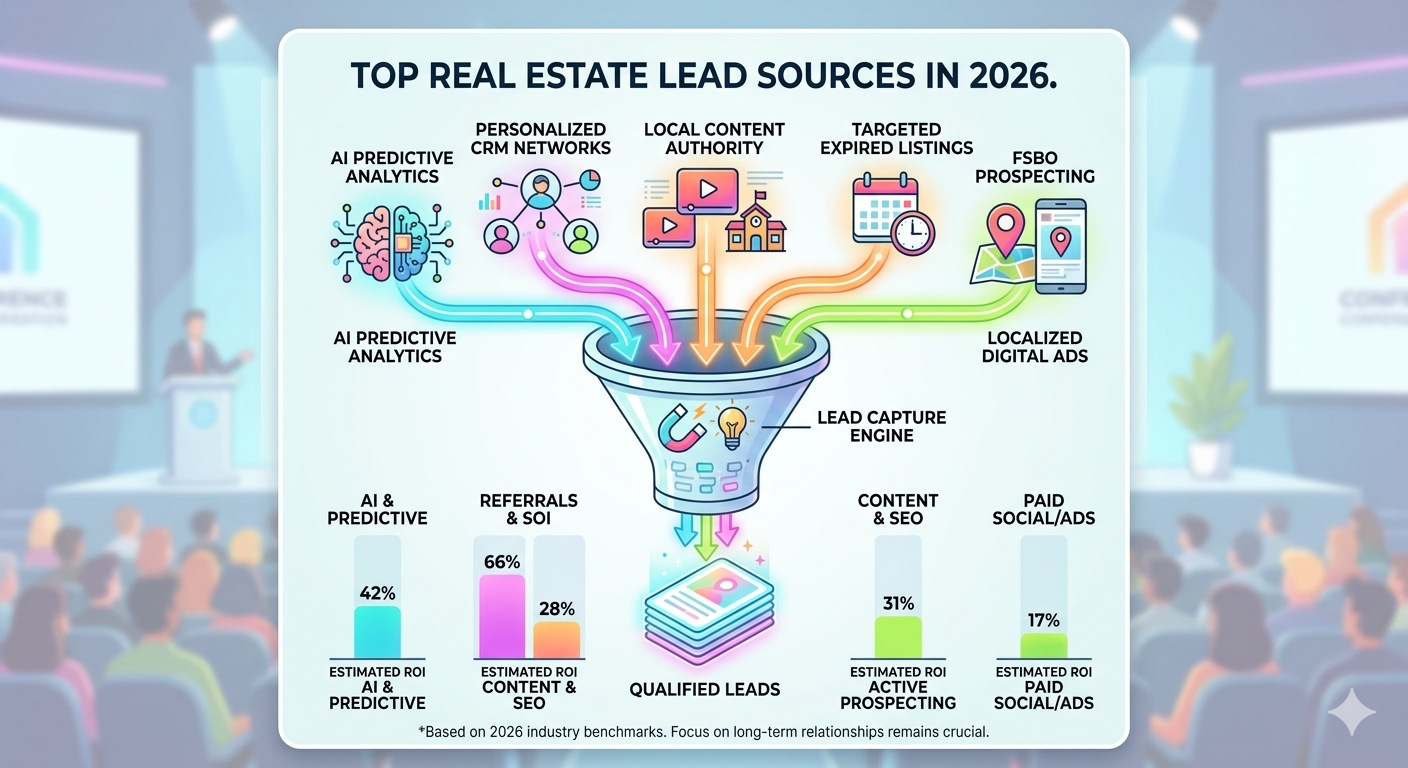
Finding the right real estate lead sources can feel like throwing darts in the dark. One agent swears by Zillow. Another says referrals are the only thing that works. A third is convinced cold calling expired listings is the secret.
The truth? They’re all right—and they’re all wrong.
The best real estate lead sources depend on your budget, your market, and your follow-up system. A source that generates 10 closings a year for one agent might deliver zero for another—not because the source is bad, but because the execution is different.
This guide breaks down every major lead source in 2026 with real costs, conversion data, and actionable steps. No fluff. No vague advice. Just what works right now.
Quick-Start: Best Lead Sources at a Glance
| Lead Source | Cost Per Lead | Best For | Time to First Lead | Conversion Potential |
| Referrals & SOI | $0 | Highest ROI, sustainable growth | Immediate | Very High |
| Expired Listings | $0–$100/mo | Listing agents, sellers | 7–21 days | High |
| Google Business Profile | $0 | Local visibility, free leads | 1–3 months | High |
| Market Leader | $30–$50 + $189/mo | Exclusive leads, solo agents | Immediate | Medium-High |
| SmartZip | ~$0.35 CPL | Predictive seller leads | Immediate | High |
| Google PPC Ads | $53–$66 | High-intent search traffic | Immediate | Medium-High |
| Zillow Premier Agent | $20–$80+ | Buyer leads, portal visibility | Immediate | Variable |
| Social Media (Organic) | $0 | Brand building, community engagement | 3–6 months | Medium |
Featured Snippet Answer: The best real estate lead sources in 2026 are referrals and repeat clients, with 80% of sellers contacting only one agent before signing a listing agreement. Expired listings convert within 7–21 days at a 44% list rate, while predictive analytics tools like SmartZip offer 72% accuracy in identifying likely sellers. For paid options, Market Leader provides exclusive leads at $30–$50 per lead, making it the best value for solo agents.
How to Evaluate Any Lead Source: The 6 Frameworks
Before you spend a dime, you need a system for evaluating lead sources. Here are the six criteria that matter most:
- Consistency — Does this source deliver leads reliably, or is it feast or famine? Paid platforms offer consistency. Referrals don’t.
- Timeliness — How quickly do leads convert? Some sources deliver hot leads ready to transact now. Others require months of nurturing.
- ROI — True ROI isn’t just cost per lead—it’s cost per closed deal. A $5 lead that never closes is more expensive than a $50 lead that closes in 30 days.
- Scalability — Can you grow lead volume without proportional time investment? Portals scale. Your sphere of influence doesn’t.
- Lead Quality — Quality = intent + trust + readiness. High-quality leads close faster and at higher rates than high-volume, low-quality leads.
- Conversion Potential — Some sources attract buyers. Others attract sellers. Sellers generate higher commissions and more referral opportunities.
Pro Tip: The best lead source is the one you follow up on fastest. Contacting a lead within 5 minutes makes you 100x more likely to convert compared to waiting 30 minutes. The average agent takes 917 minutes—over 15 hours—to respond to a new lead. That’s the biggest leak in most agents’ pipelines.
S-Tier Lead Sources: Highest ROI Channels
These sources deliver the best return on investment. They may not be the cheapest in dollar terms, but they cost the least in wasted time and low-quality leads.
1. Referrals & Your Sphere of Influence
Referrals are the gold standard of real estate leads. A 2024 NAR survey found that 38% of sellers found their agent through a referral from a friend, neighbor, or relative. Even more telling: 80% of sellers contact only one agent before signing a listing agreement. If you’re that agent, the deal is yours.
Key Data:
- 66% of sellers hire a referred agent or one they’ve worked with before
- 80% of sellers contact only one agent before signing
- Referral conversion rates are 3–4x higher than online leads
- 41% of the typical agent’s annual revenue comes from repeat and referral business
How to Make It Work:
- Create a past client database with birthdays, anniversaries, and homeownership milestones
- Send handwritten notes, market updates, and home value reports quarterly
- Host client appreciation events
- Ask for referrals at the closing table and 6 months post-closing
- Partner with mortgage lenders, home inspectors, and title companies for B2B referrals
Pro Tip: “The best agents don’t chase leads—they build relationships. Every satisfied client is a potential referral source for life.”
2. Expired Listings
Expired listings are one of the most overlooked goldmines in real estate. These are homeowners who already listed, already wanted to sell, and didn’t get the outcome they expected. That makes them one of the highest-intent sources available.
Key Data:
- REDX tracked 2.7 million expired and FSBO leads across all 50 states and found a 44% list rate and a 20.7% sold rate
- More than 78,000 listings now expire off the MLS every single week, up 83% from 2024
- First appointments come in 7–21 days
- Data costs run $1–$3 per record, making cost per closed deal as low as $150
How to Make It Work:
- Set up REDX, Vulcan 7, or similar tools for daily expired alerts
- Create a script that addresses seller frustration without being salesy
- Call within the first 24 hours—speed matters more than script quality
- Offer a “pre-listing consultation” to diagnose why their home didn’t sell
- Follow up 3–5 times before moving on
Pro Tip: The “golden hour” of expired prospecting is the first 24 hours. Every agent with the same data subscription sees the same names every morning. The one who calls first wins.
3. Google Business Profile & Local SEO
Your Google Business Profile is a free digital storefront that generates leads while you sleep. It’s the #1 local search visibility tool, and it costs nothing but time.
Key Data:
- Organic search accounts for 42.1% of traffic to real estate websites in the U.S.
- 68.5% of real estate traffic comes from mobile devices
- 47% of buyers cite an agent’s technology skills as “very important” in choosing whom to work with
How to Make It Work:
- Claim and verify your Google Business Profile
- Add 15–20 high-quality photos of your listings, neighborhood landmarks, and yourself
- Post weekly market updates, new listings, and sold properties
- Respond to every review within 24 hours—positive and negative
- Use the Q&A feature to answer common buyer and seller questions
Pro Tip: Creating hyperlocal content—neighborhood guides, community events, school district info—positions you as a trusted advisor rather than just another “lead source.”
4. YouTube & Organic Content
YouTube is the second-largest search engine, and real estate content performs exceptionally well. Property walkthroughs, market updates, and neighborhood tours generate organic traffic that compounds over time.
Key Data:
- SEO delivers a 1,389% ROI over time
- Organic traffic costs $15–$50 per lead after initial traction
- Content marketing leads start at $80–$100 each in the first 3–6 months, dropping to $7–$30 once content gains organic traction after 12–24 months
How to Make It Work:
- Create neighborhood-specific videos using keywords people search for
- Embed videos on your website and share across social platforms
- Use YouTube Shorts for quick tips and local market data
- Include calls-to-action in every video: “Call me for a free home valuation”
- Consistency beats perfection—start with one video per week
Pro Tip: YouTube videos rank on Google. A single well-optimized video can generate leads for years with zero additional cost.
Paid Lead Platforms: Buy Leads with Budget
Paid lead sources are the fast track to building your pipeline. They deliver immediate results—if you have a follow-up system ready to receive them.
5. Market Leader
Market Leader is the best value for solo agents who want exclusive, predictable leads without breaking the bank.
Pricing & Details:
- Solo agents: $189 per month + $30–$50 per lead
- Teams: $329 per month for up to 10 users
- Network Boost: $300 per month for 30 social media leads
- Minimum six-month contract
What It Includes:
- Exclusive leads delivered monthly
- Built-in CRM
- Email and SMS marketing automation
- Lead capture forms
- Mobile app with real-time push notifications
Pros: Lead exclusivity, guaranteed volume, affordable entry point
Cons: Six-month contract, limited analytics, no trial period
Pro Tip: Market Leader is ideal for newer and mid-career agents who need consistent lead flow without the complexity of managing multiple platforms.
6. SmartZip
SmartZip is the sleeper pick for seller leads. It uses predictive analytics to identify homeowners most likely to sell within 18 months, helping you focus outreach on high-probability targets.
Pricing & Details:
- Setup fee: $396
- Monthly: $99+
- Cost per lead: ~$0.35
- 72% prediction accuracy using data from 25+ sources
How It Works:
SmartZip aggregates data from sources like CoreLogic, ATTOM, Experian, Cole, Tax Records, and Quicken Loans to analyze consumer behavior and predict seller likelihood. It identifies the 15–20% of homeowners most likely to sell in the near future, allowing you to focus your marketing efforts with precision.
Pros: Affordable high-intent seller leads, scalable across multiple ZIP codes
Cons: Requires 12+ months of consistent farming, not for agents without a geographic farm
Pro Tip: SmartZip is ideal for agents who think long-term. Treat every predicted seller lead as a future listing—nurture them with market data and personalized content for 18 months.
7. Zillow Premier Agent
Zillow Premier Agent is the 800-pound gorilla of real estate lead generation. It generates leads, but the economics are shifting.
Pricing & Details:
- Cost per lead: $20–$80 on average, up to $150–$400+ in competitive markets
- Monthly budgets: $300–$1,000+
- Leads shared with multiple agents
- Conversion rate: 0.5%–3% for most agents
The Math:
Portal leads cost $2,500–$8,000 per closed deal for solo agents. The average agent takes 917 minutes—over 15 hours—to respond to a new lead. If you’re not responding within 5 minutes, you’re lighting money on fire.
Pros: High-intent leads, immediate volume, 227 million monthly unique users
Cons: Skyrocketing costs, low conversion rates, shared leads, requires elite follow-up
Pro Tip: Zillow works for agents with dedicated ISAs (Inside Sales Agents) and instant-response systems. Solo agents should start with less expensive options and graduate to Zillow once they have the infrastructure to convert leads profitably.
8. REDX
REDX provides expired listings, FSBOs, pre-foreclosures, and absentee owners with a la carte pricing and an automated dialer.
Pricing & Details:
- From $50 per month
- A la carte lead packages
- Automated dialer included
Key Data:
- 44% list rate and 20.7% sold rate on expired listings
- 2.7 million expired and FSBO leads tracked across all 50 states
- First appointments in 7–21 days
Pros: Affordable, high-intent seller leads, no minimum monthly commitment, automated dialer included
Cons: Requires phone prospecting skills, competitive (other agents call same leads)
Pro Tip: Expired listings are the fastest path to a listing appointment. Call 50–100 expired listings weekly with a script that addresses seller frustration. The first agent to call often wins.
9. Google PPC Ads
Google captures people at the exact moment they search for “sell my house” or “real estate agent near me.” That intent is valuable.
Pricing & Details:
- CPC (Cost Per Click): $2.95
- Conversion rate: 3.80%
- CPL: $53–$66
- Cost per closed deal: $1,400–$3,500
Pros: High-intent search traffic, immediate results, scalable budget
Cons: Requires ongoing management, competitive keywords are expensive
Pro Tip: Agents who fail with Google Ads usually don’t have a traffic problem—they have a follow-up problem. Without a system to nurture leads over 30–90 days, you’re paying for clicks that go cold.
10. CINC
CINC is an end-to-end lead generation platform for agents ready to scale aggressively.
Pricing & Details:
- Solo agents: from $899 per month
- Teams: from $1,299 per month
- Includes IDX website, CRM, lead generation, and ISA support
Pros: Complete lead generation ecosystem, ISA support, powerful automation, industry-leading CRM
Cons: Expensive for new agents, steep learning curve
Pro Tip: CINC is best for agents already closing 20+ deals annually who want to scale to 50+. If you’re a solo agent, start with Market Leader or Zillow before committing to CINC.
11. BoomTown
BoomTown offers all-in-one lead generation, routing, follow-up, and reporting for serious agents.
Pricing & Details:
- Custom pricing (reported at $250–$600+/month)
- Includes social and search advertising
- Lead routing and distribution
- Detailed analytics dashboard
Pros: Comprehensive features, integrated marketing, lead routing, analytics
Cons: Reports of customer support issues, expensive
Pro Tip: Like CINC, BoomTown is designed for agents with volume goals. Don’t buy this as a solo agent with a $500 budget.
12. Realtor.com Connections Plus
Realtor.com is the official website of the National Association of Realtors, making it a trusted brand.
Pricing & Details:
- Average lead cost: $62 (lower than Zillow)
- Connection Plus: $15–$30 per contact, lower overall monthly fees
- Shared and exclusive leads available
Pros: Realtor.com is the official NAR website, lower per-lead price than Zillow, integrated CRM with lead management, lead analytics
Cons: Lead volume lower than Zillow, competitive markets still expensive
Pro Tip: Realtor.com leads have a slightly lower CPL but lower conversion rates than Zillow. Agents who succeed use their CRM to tag and nurture leads over time.
13. Real Geeks
Real Geeks focuses on lead generation through AI-powered chatbots and IDX websites.
Pricing & Details:
- Most expensive: $650–$1,000+/month
- AI-powered chatbot captures leads 24/7
- IDX website with lead capture
- Built-in marketing automation
Pros: AI chatbot captures leads automatically, integrated IDX website, marketing automation, lead routing
Cons: High monthly cost, steep learning curve, reports of poor customer support
Pro Tip: Real Geeks is best for agents who want an automated “24/7 lead capture” system. It’s a “catch all” source that requires a dedicated follow-up system.
14. Zurple
Zurple is an AI-powered lead generation and nurturing platform.
Pricing & Details:
- Reported at $250–$500/month + per-lead fees
- Targets high-intent buyers and sellers
- AI-powered lead nurturing
- Integrates with most major CRMs
Pros: Targets high-intent prospects, AI-powered lead nurturing, integrates with major CRMs
Cons: Contract-based, reports of poor lead quality, expensive
Pro Tip: Zurple is designed to scale with agent teams. As a solo agent, focus on sources like Market Leader that deliver guaranteed volume.
15. PropertyBase
PropertyBase is a low-cost lead generation platform that uses seller behavior to generate listing appointments.
Pricing & Details:
- Lowest option: $69/month for 14-day trial, then $149/month + costs per appointment
- Uses behavioral triggers to identify seller intent
- Designed for listing agents
- Appointment-setting included
Pros: Appointment-setting service, low-cost entry point, buyer and seller leads, free local expertise reports, mobile app, 30-day risk-free trial
Cons: Inconsistent lead quality, leads capped per zip code, requires active work
Pro Tip: PropertyBase’s appointment-setting takes the prospecting burden off you. Try the 14-day trial to see if lead quality matches your market.
Seller-Specific Lead Sources
Seller leads are the holy grail. Sellers generate higher commissions, bigger transaction volumes, and more referral opportunities. Here are the best sources specifically for generating seller leads.
16. Predictive Analytics (SmartZip & Offrs)
Predictive analytics identifies homeowners likely to move within 6–12 months based on property data, demographic shifts, and behavioral signals.
Key Data:
- SmartZip achieves 72% prediction accuracy using data from 25+ sources
- Offrs’ proprietary algorithm is more than 70% accurate in most markets
- Focuses outreach on 15–20% of homeowners most likely to sell
How It Works:
These platforms analyze variables about individual properties and local markets to predict which property owners are most likely to list their home. They make it easy to coordinate targeted marketing campaigns and convert leads to listings.
Pro Tip: Predictive analytics gives you a 3–6 month head start over other agents. You’re identifying sellers before they hit the market.
17. FSBOs (For Sale By Owner)
FSBO sellers are motivated—they want to sell, they just don’t want to pay a commission. Many become frustrated and list with an agent after a few months.
Key Data:
- FSBO sellers often become frustrated after 30–60 days without selling
- These leads are high-intent, but require consultative outreach
- Many FSBOs have unrealistic expectations about time and price
How to Make It Work:
- Identify FSBOs in your market using REDX or similar tools
- Reach out with a value proposition: “I can sell your home for more than you can, and here’s the data”
- Offer a free market analysis to demonstrate your value
- Don’t be pushy—be helpful
Pro Tip: FSBO prospecting follows the same playbook as expired listings. The phone still works when you actually pick it up.
18. Absentee Owners
Absentee owners own property but don’t live there. Many are considering selling because they’re tired of managing from a distance.
How to Make It Work:
- Use PropStream or REDX to identify absentee owners
- Look for properties with high equity and long-term ownership
- Reach out with a personalized letter asking if they’d consider selling
- Offer a no-obligation market analysis
Pro Tip: Absentee owners are often open to selling because they’re dealing with property management headaches. A simple “I can make this easy for you” pitch works well.
Social Media & Digital Channels
Social media continues to grow as a lead generation channel. Video content on Instagram and TikTok is driving the biggest gains.
Key Data:
- Social media commands 17.1% of traffic to real estate websites in the U.S.
- TikTok engagement rate: 4.10%
- Instagram engagement rate: 1.85%
19. Instagram & Facebook Ads
Meta Lead Ads capture contact information directly within the platform, reducing friction for users.
Pricing & Details:
- Facebook CPC: $1.05
- Facebook conversion rate: 1.25%
- CPL: $5–$25
- Time to close: 6–12+ months (requires nurturing)
Pros: Low CPL, wide reach, targeted demographics, retargeting options
Cons: Low intent leads (requires significant follow-up), long time-to-close
Pro Tip: Facebook’s cheap CPL looks good until you realize those leads need 6–12+ months of nurture. Most agents quit after 90 days and call it a failure—they never gave the channel its natural close cycle.
20. TikTok & Short-Form Video
TikTok has the highest engagement rate of any social platform for real estate content at 4.10%. Short-form video is the primary driver of social media growth in real estate.
How to Make It Work:
- Post property walkthroughs, market updates, and local tips
- Maintain a 3–5x per week cadence
- Mix market updates, property showcases, and community content
- Use relevant hashtags and local keywords
Pro Tip: TikTok’s audience is younger, but that’s changing fast. 60% of TikTok users are now over 30. If you’re ignoring it, you’re ignoring a growing demographic.
Traditional & Relationship-Based Channels
21. Open Houses
Open houses generate buyer leads—often high-intent ones who are actively looking.
Key Data:
- 10–15% conversion rate for new buyer agents
- 48% of buyers attend open houses during their home search
- Cost: $0–$200 for staging and signs
How to Make It Work:
- Host open houses in your best listings or partner with other agents
- Use Spacio or Curb Hero for digital check-in and lead capture
- Send follow-up emails/texts within 2 hours
- Add attendees to your nurture sequence
Pro Tip: Open houses are ROI-positive if you collect contact information and follow up within 5 minutes of the open house ending.
22. Networking & Community Events
Being visible in your community generates organic referrals. Attend local chamber of commerce meetings, school events, and charity fundraisers. Show up consistently—not just when you need business.
Key Data:
- 38% of sellers found their agent through a referral from a friend, neighbor, or relative
- 41% of the typical agent’s annual revenue comes from repeat and referral business
Pro Tip: The best agents are the ones people in the community know and trust. Show up consistently, not just when you need business.
What’s NOT Working in 2026
According to the 2025 NAR Profile, buyer demographics have shifted significantly:
- First-time buyers are now just 21% of the market, down from 40% pre-2008
- Buyers now prioritize proximity to family (52%) over job proximity (31%)
- 28% of buyers declare they never intend to move again
- Homeowners now expect to stay in their homes 15 years—the longest tenure NAR has recorded
Channels to Avoid:
- Radio Ads: Hard to track, untargeted, non-scalable
- Newspaper Ads: Declining readership, low ROI
- Untargeted Direct Mail: Low efficiency, hard to measure
- Shopping Cart Ads: Low intent, poor conversion
Key Insight: The demographic shift means agents need to focus on repeat buyers and sellers over 55, not first-time buyers. If your lead strategy doesn’t target this demographic, you’re missing the biggest opportunity in the market.
How to Build Your Lead Generation System: Action Plan
Lead sources are only half the equation. A lead generation system integrates sources, follow-up, CRM, and attribution.
Step 1: Allocate Budget by Business Stage
| Business Stage | Recommended Budget Allocation |
| New Agent (< 1 year) | Referrals (free) + Expired Listings ($50/mo) + Open Houses (free) |
| Growing Agent (1–3 years) | Referrals + Market Leader ($189/mo + leads) + Google PPC ($500/mo) |
| Established Agent (3–5 years) | Referrals + Market Leader + SmartZip ($500/mo) + Facebook Ads |
| Top Producer (5+ years) | Referrals + Multiple paid sources + ISA + Predictive Analytics |
Step 2: Lead Source + CRM + Follow-Up
- Every lead must enter your CRM within 5 minutes of capture
- Assign lead type (A/B/C) based on timeline
- Set up automated nurture sequences (1, 3, 7, 14, 30, 90 days)
- Dial leads personally within 24 hours of capture
CRM Recommendations:
- Follow Up Boss: $58/month, integrates with 250+ apps
- Wise Agent: $41.58/month for budget solo agents
- CINC: $899+/month for all-in-one teams
Step 3: Track ROI
- Formula: (Net Commission Income − Total Channel Cost) / Total Channel Cost
- Track CPL, conversion rate, and time-to-close per source
- If a source isn’t delivering >100% ROI, pause and redirect budget
Pro Tip: The 5-Minute Rule—agents who respond within 5 minutes are 100x more likely to convert than those who wait 30 minutes. Use a CRM that alerts you immediately when a lead arrives.
FAQ
Q: What is the best real estate lead source in 2026?
A: Referrals and repeat clients are the most effective, with 80% of sellers contacting only one agent before signing a listing agreement. Expired listings are the fastest paid alternative, with first appointments in 7–21 days and a 44% list rate.
Q: Are Zillow leads worth the cost?
A: It depends on your market and follow-up skills. Portal leads cost $2,500–$8,000 per closed deal for solo agents. If you don’t respond within 5 minutes, you’re wasting money. Agents with dedicated ISAs and instant-response systems can make Zillow work profitably.
Q: What is the best paid lead source for seller leads?
A: SmartZip offers 72% prediction accuracy at ~$0.35 per lead. REDX delivers expired listings with a 44% list rate. Market Leader guarantees exclusive leads at $30–$50 per lead.
Q: How much should agents spend on lead generation?
A: Start with $0 methods (referrals, expired listings, open houses). As you grow, allocate 10–20% of your gross commission income to lead generation. The key is to invest only in sources that deliver positive ROI.
Q: Are paid leads or free leads better?
A: Successful agents mix both. Paid leads deliver immediate results; free leads (referrals, content, SEO) deliver sustainable, high-ROI results over time. The best strategy is to use paid sources for pipeline building and free sources for long-term profitability.
Q: Is social media effective for real estate lead generation?
A: Yes. Social media commands 17.1% of traffic to real estate websites in the U.S. TikTok engagement is 4.10%, the highest among platforms. However, social media leads typically take 6–12+ months to close, so patience is required.
Q: What lead sources should agents avoid in 2026?
A: Avoid radio ads, newspaper ads, untargeted direct mail, and shopping cart ads. These have poor ROI,low intent, and are hard to track.
Q: What is the fastest way to get a real estate lead?
A: Paid sources like Zillow, Market Leader, and Google PPC deliver leads immediately. Expired listing prospecting via REDX also delivers fast results—first appointments in 7–21 days.
Q: How many lead sources should I use?
A: Pick two sources and master them. Don’t add a third until the first two are profitable. Spreading across 10 channels means you never reach proficiency on any of them.
Q: What is the most underrated lead source?
A: Expired listings. More than 78,000 listings expire off the MLS every single week, up 83% from 2024. These homeowners already wanted to sell—they just didn’t get the outcome they expected. They’re the highest-intent source most agents ignore.